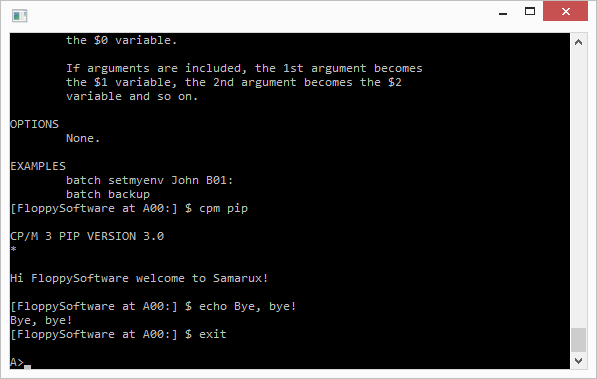
I am working in my old project to build a *nix shell type for CP/M in MESCC.
Over the time, it has gain a lot of functionality and new commands.
It has now pipes, redirection, environment variables and aliases.
It has many built-in commands: cat, more, pwd, ls, rm, mv, echo, batch, man, etc. and it's able to execute CP/M programas too (well, by using the $$$.SUB trick).
It can execute a profile file to set-up the environment and aliases.
It can execute Samarux built-in commands directly from the CP/M CCP command line.
Samarux, (this is its name), can run on any computer running any CP/M version on a Z80 cpu.
My intention is to release the Samarux under the GLP license.
When?
Well, very soon, I hope.
This is my blog dedicated to the world of the CP/M OS, the Z80 CPU, the AMSTRAD PCW computer and related subjects.
Sunday, January 4, 2015
Samarux, *nix shell for CP/M
Labels:
C Programming,
CP/M,
MESCC,
Small C,
Z80
Saturday, August 30, 2014
WTD / What To Do v1.0 - Released
WTD / What To Do v1.0, released under the GPL license, source code included.
WTD is a "to do list" manager for the CP/M operating system and the Z80 cpu.
It has been written in MESCC, and follows the format and rules of Gina Trapani and his todo.txt system.
You can download from my website.
By the way, it has been ported from MESCC to Pelles C for Windows in a hurry (more information on this soon).
Friday, August 22, 2014
WTD for CP/M - What To Do (to do list manager)
I am writting a new program for CP/M with MESCC.
Its name is WTD / What To Do, and is a "to do list manager".
I uses the same format as "todo.txt" system by Gina Trapani: http://todotxt.com/, simple but very effective.
My intention is to use WTD in my daily job tasks.
More information soon.
Its name is WTD / What To Do, and is a "to do list manager".
I uses the same format as "todo.txt" system by Gina Trapani: http://todotxt.com/, simple but very effective.
My intention is to use WTD in my daily job tasks.
More information soon.
Wednesday, August 6, 2014
UMMO - New game for the Amstrad PCW
I have developed a new game for the Amstrad PCW.
Its name is UMMO, and is a classical "kill the invaders" game, with some asteroids too.
It has been developed with MESCC, my own version of the Small C compiler, some libraries from SAMARUC, my GUI for the Amstrad PCW, and a game engine called TWO (The World Of) inspired in Greenfoot.
It runs from CP/M.
You can download from my website http://www.floppysoftware.es.
Sunday, July 20, 2014
Find that Mine! for CP/M & Z80
I have developed a version of my game Find that mine! for CP/M.
It is derived from the source code of the Amstrad PCW and my GUI Samaruc, and it should run on any Z80 computer running any version of CP/M.
It has been write with MESCC, my own version of Small C Compiler, and it has been released under the GNU General Public License, source code included.
And... yes, it's another clon of MineSweeper!
You can download from my website: www.floppysoftware.es
Labels:
C Programming,
CP/M,
Find That Mine!,
MESCC,
Small C,
Z80
Tuesday, February 4, 2014
CP/M: 40 años
CP/M cumple 40 años.
Para celebrarlo, el Institute of Electrical and Electronic Engineering (IEEE) de New York, instalará una placa conmemorativa en los alrededores de lo que fue el edificio de Digital Research Inc. en Pacific Grove, California, el próximo 25 de abril de 2014.
Fuente: https://www.facebook.com/KildallLegacy
An IEEE Milestone plaque to commemorate Gary Kildall’s development of the first disk-based operating system for microcomputers to be dedicated on 4/25/14
Descripción
Gary Kildall's CP/M, the first disk-based operating system for microcomputers, kick-started the personal computer revolution in Pacific Grove, CA in the fall of 1974
An instructor in computer science at the Naval Postgraduate School in Monterey and a consultant to Intel Corporation, Dr. Gary A. Kildall founded Digital Research Inc. (DRI) in Pacific Grove, CA to commercialize CP/M that together with his Basic Input Output System (BIOS) concept kick-started the PC revolution. By 1980, Kildall had sold “millions of copies to manufacturers and end-users” and employed several hundred people in Pacific Grove. Sales continued to grow and expanded into other areas of computer software, including CD ROMs, educational tools, networking, and a video animation program that was purchased by a “little company called Pixar.” Towards the end of the decade DRI faltered and in 1991 Novell Inc. purchased the assets. Gary Kildall died following an accident in 1994 but the legacy of his work lives on as the forerunner of the operating systems that continue to power the majority of the world’s computers.
The Institute of Electrical and Electronic Engineering (IEEE), the New York-based “world’s largest professional organization for the advancement of technology”, Milestone program honors important events in electrical engineering and computing. Achievements such Thomas Edison’s electric light bulb, Marconi’s wireless communications, and Bell Labs first transistor are recognized with a commemorative plaque in an appropriate location. To coincide with the 40th anniversary year of the CP/M prototype, the IEEE will install a bronze Milestone plaque outside the former DRI headquarters at 801 Lighthouse Avenue, Pacific Grove, CA.
Sunday, August 4, 2013
DeskJoy, a simple desktop utility to run programs for the Amstrad PCW
It is available in my website another program developed with Samaruc and MESCC: DeskJoy, a desktop utility with the ability of run programs on the Amstrad PCW, with icons, windows, menus, buttons, etc.
It can run CP/M programs and it has some internal utilities too (Character map, Screen Saver, Samaruc Control Panel).
It can create new links, modify them, erase them, move them, etc.
You can set some properties for each link: title, command line, icon, screen, enable the cursor, set pause after run the program, etc., to help to configure the environment for the program.
If you want, You can edit the command line before running the program, or do a pause when the program has ended.
Some example links and the newer versions of The Same Game and Find that mine! are included in the disk.
Labels:
Amstrad PCW,
CP/M,
DeskJoy,
MESCC,
Samaruc GUI,
Z80
Subscribe to:
Posts (Atom)